


Choosing the Right Mobility Aid: Cane, Walker, or Wheelchair?
Cane, walker, or wheelchair? It's not about severity — it's about finding the right fit. Here's a guide to help you choose the mobility aid that actually matches your needs.
Mobility challenges rarely show up all at once — they tend to creep in gradually, which makes it hard to know exactly when (or with what) to start getting support. A cane might feel like "giving in," a walker might seem excessive, and a wheelchair can feel like a bigger step than what's actually needed. The truth is, the right mobility aid isn't about severity or pride — it's about matching the right tool to the right need.
This guide breaks down the differences between canes, walkers, and wheelchairs, so you can have a more informed conversation with your doctor or care team about what's right for you or a loved one.
Canes: Best for Mild Balance or Stability Support
A cane is generally the right fit when someone needs a little extra stability or balance support, but still has reasonably good strength and coordination.
Good fit if:
Balance is slightly off, but walking itself isn't a major struggle
Only mild support is needed, often on one side
The person can bear full weight on both legs without difficulty
Types to know:
Single-point canes — the most common type, best for general balance support
Quad canes — have a four-point base for extra stability, often recommended after a stroke or for more significant balance issues
Keep in mind: A cane should be sized so the elbow bends slightly (around 15 degrees) when holding the handle. An incorrectly sized cane can actually make balance worse, not better.
Walkers: Best for More Significant Balance or Weight-Bearing Support
A walker offers substantially more stability than a cane, since it provides a wider base of support and allows more weight to be distributed across the arms.
Good fit if:
Balance issues are more significant, or there's a real fall risk
Extra support is needed on both sides, not just one
Some weight-bearing limitation exists (such as recovering from hip or knee surgery)
Types to know:
Standard walkers — no wheels, requiring the walker to be lifted slightly with each step; offer the most stability
Two-wheeled walkers — front wheels allow for a smoother, more continuous gait
Four-wheeled walkers (rollators) — often include a seat and brakes, better suited for those who don't need to lean heavily on the walker for weight-bearing support
Wheelchairs: Best When Walking Isn't Safe or Sustainable
A wheelchair is typically appropriate when walking — even with a walker — isn't safe, sustainable, or possible for longer distances.
Good fit if:
Standing or walking puts the person at high fall risk
Endurance is too limited to walk more than very short distances
A medical condition significantly limits mobility (certain neurological conditions, severe arthritis, recovery from major surgery, etc.)
Types to know:
Manual wheelchairs — require the user or a caregiver to propel them; a good fit when some upper body strength is available
Transport chairs — lighter-weight, designed to be pushed by a caregiver rather than self-propelled
Power wheelchairs — battery-operated, appropriate when upper body strength isn't sufficient for manual propulsion
How to Decide: A Few Guiding Questions
If you're still not sure which category fits, these questions can help guide the conversation with a doctor or physical therapist:
How far does the person need to walk regularly — just around the house, or longer distances?
Has there been a recent fall, or a growing fear of falling?
Is there a weight-bearing restriction from a recent injury or surgery?
Does the person have enough upper body strength to use a cane or walker safely?
Is the concern mainly balance, mainly endurance, or both?
It's Not Always One or the Other
Many people actually use more than one mobility aid depending on the situation — a cane for short trips around the house, and a wheelchair for longer outings, for example. There's no single "right" answer that applies to everyone, which is exactly why this decision works best with input from your doctor, a physical therapist, and a DME provider who can help match the equipment to your specific needs.
We Can Help You Choose — and Get It Covered
Our team works directly with your physician to determine the right mobility equipment for your situation, handle the necessary documentation, and walk you through your coverage options — whether that's through insurance, a Single Case Agreement, or transparent self-pay pricing.
Not sure which mobility aid is right for you or a loved one? Email us at info@contactmed.net or call us at (770) 858-5238 to talk with our team.
This post is for general informational purposes and is not a substitute for medical advice. Please consult your doctor or physical therapist to determine the right mobility aid for your specific situation.
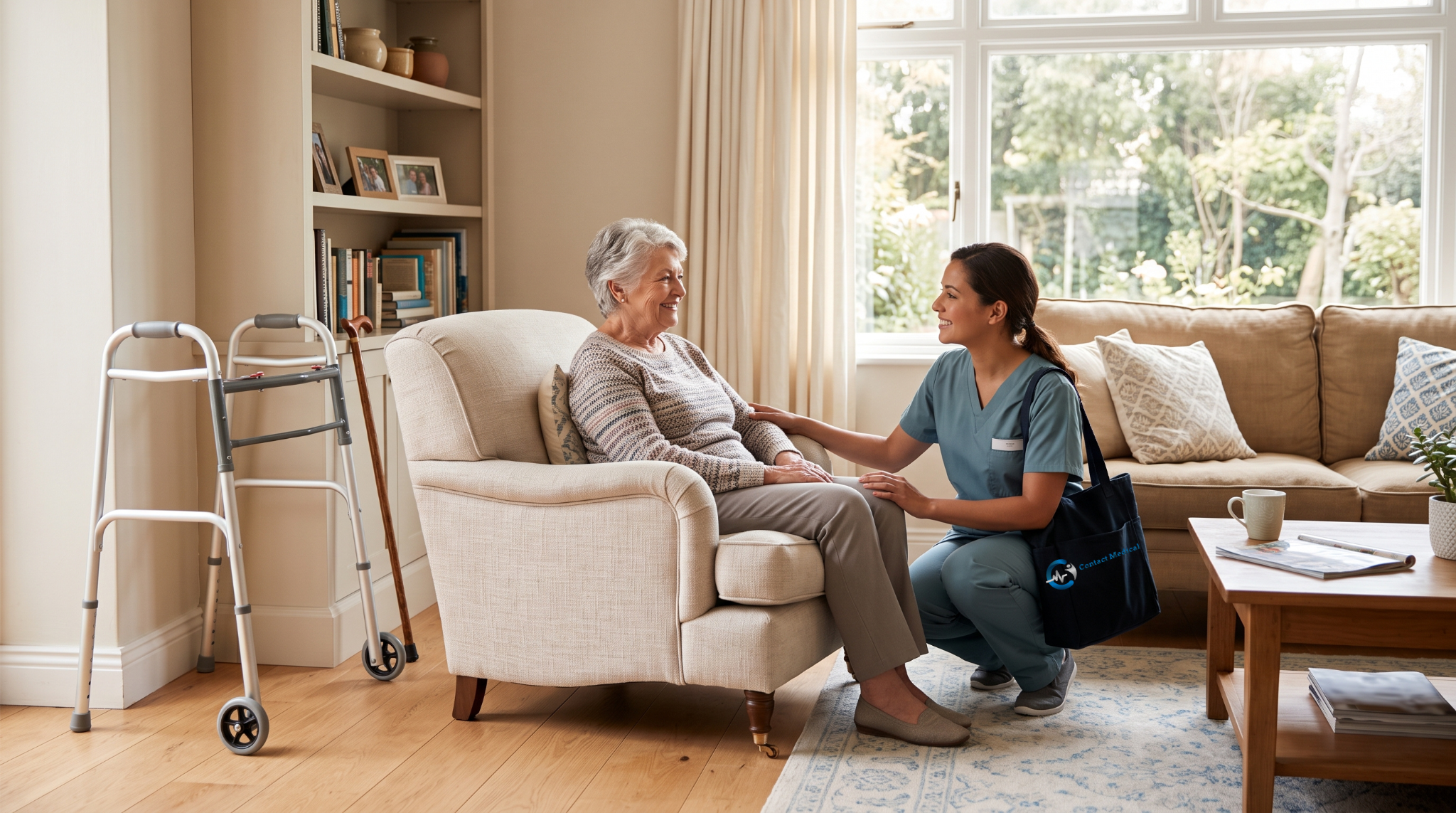
Aging in Place: How Home Health & DME Help Seniors Stay Independent Longer
Home isn't just a place—it's independence. Discover how home health care and equipment help seniors stay safely where they belong.
Every August 21, National Senior Citizens Day reminds us to celebrate the older adults in our lives — but for those of us in home health and durable medical equipment (DME), that appreciation shows up in our work every single day. Most seniors, when asked, say the same thing: they want to stay in their own home for as long as possible. That preference has a name — aging in place — and it's more achievable today than ever, with the right support.
In this post, we'll look at what aging in place really means, the biggest challenges seniors face in doing it safely, and how home health services and DME work together to make it possible.
What Does "Aging in Place" Actually Mean?
Aging in place simply means living in your own home and community safely, independently, and comfortably, regardless of age or ability level — rather than moving to a nursing home or assisted living facility. For many seniors, it's not just a preference; it's tied to dignity, familiarity, and quality of life.
But aging in place doesn't mean aging alone or without support. It means bringing the right care and resources to the home, instead of moving the person away from it.
The Biggest Challenges to Staying Home Safely
Most seniors don't leave their homes because they want to — they leave because a specific problem becomes too hard to manage. The most common ones we see include:
Fall risk. Falls are one of the leading causes of injury-related hospitalization for older adults, often triggered by poor mobility support, loose rugs, or a lack of grab bars and safety equipment.
Difficulty managing chronic conditions. Diabetes, COPD, heart failure, and similar conditions often require regular monitoring that's hard to keep up with alone.
Recovery after a hospital stay. Post-surgical or post-hospitalization recovery at home can be daunting without skilled nursing support.
Mobility limitations. Getting in and out of bed, the shower, or a chair safely often requires equipment that wasn't needed a few years earlier.
Isolation. Physical challenges often lead to reduced social contact, which affects mental health as much as physical health.
The good news: nearly all of these are manageable with the right combination of home health services and equipment.
How Home Health Services Support Aging in Place
Skilled home health care brings medical support directly into the home, including:
Skilled nursing visits for wound care, medication management, and monitoring chronic conditions
Physical and occupational therapy to maintain or rebuild strength, balance, and independence with daily tasks
Post-hospital recovery support to reduce the risk of readmission
Health monitoring that catches small issues before they become emergencies
How DME Fills in the Gaps
Durable medical equipment addresses the physical safety side of independent living. Common examples include:
Mobility aids — walkers, wheelchairs, and canes suited to the individual's needs
Hospital beds for those who need positioning support or easier transfers
Bathroom safety equipment — grab bars, shower chairs, and raised toilet seats to prevent one of the most common fall locations
Patient lifts to safely assist transfers for those with limited mobility
The right equipment, matched to the right need, is often the difference between a close call and a safe recovery.
When to Start the Conversation
You don't need to wait for a crisis to start planning for aging in place. Good moments to start the conversation include:
After a fall, even a minor one
Following a hospital stay or new diagnosis
When a loved one starts showing signs of struggling with daily tasks
When family members live far away and worry about day-to-day safety
We're Here to Help
Whether you're a senior planning ahead, or a family member trying to support a parent or loved one, our team can help put together the right combination of home health services and equipment — and we'll work with you on coverage, whether that's through your insurance, a Single Case Agreement, or self-pay options.
This National Senior Citizens Day, we're honoring the seniors we serve by continuing to do what we do best: helping people stay safe, supported, and at home.
Have questions about care options for yourself or a loved one? Email us at info@contactmed.net or call us at (770) 858-5238 to talk with our team.
This post is for general informational purposes and is not a substitute for medical advice. Please consult a healthcare professional to determine the right care plan for your specific situation.

How to Prepare for a Home Health Nurse's First Visit
Home health nurse's first visit coming up? A little prep goes a long way. Here's a simple checklist to help ease the nerves — what to gather, what to expect, and what to do after.
If you or a loved one has a home health nurse's first visit coming up, it's completely normal to feel a little uncertain about what to expect. Will they need paperwork? Should the house be spotless? What if you forget to mention something important?
Take a breath — a little preparation goes a long way, and this checklist will help the first visit go smoothly for everyone involved.
Before the Visit
Gather Your Medical Information
Having key documents on hand saves time and helps your nurse get a full picture of your health. Try to have the following ready:
A current list of all medications, including dosages and how often they're taken
Names and contact information for your primary doctor and any specialists
Recent hospital discharge paperwork, if applicable
Insurance card and ID
A list of known allergies
Write Down Your Questions and Concerns
It's easy to forget questions in the moment, especially if you're feeling anxious. Keep a running list in the days leading up to the visit — no question is too small. Common ones include:
How often will visits happen, and how long will they last?
What should I do if I have a concern between visits?
What symptoms should prompt an immediate call versus waiting for the next scheduled visit?
Tidy Up Key Areas — But Don't Stress About Perfection
Your nurse isn't there to judge your housekeeping. That said, it helps to have a few things in place:
Clear a path to a well-lit area where the nurse can examine you comfortably, such as a chair or bed
Have good lighting available in that space
Keep pets secured in another room during the visit, unless otherwise discussed
Have a Support Person Present, If Possible
If you're helping a parent or loved one, try to be there for at least the first visit. An extra set of ears helps make sure nothing important gets missed, and it gives the nurse a chance to answer caregiver-specific questions too.
During the Visit
Be Honest About Symptoms and Challenges
Nurses are there to help, not to judge. If you've been skipping medications, struggling with a task, or feeling overwhelmed, saying so helps your nurse build a care plan that actually fits your real life — not just the version that sounds good on paper.
Ask About the Plan of Care
By the end of the first visit, you should have a general understanding of:
What the goals of care are
How often the nurse (or other home health team members) will visit
What role, if any, other services like physical therapy or home health aides might play
Any equipment that might be recommended
Don't Be Afraid to Ask Things Twice
There's often a lot of information shared in a first visit. If something doesn't make sense, ask again — a good home health nurse expects and welcomes these questions.
After the Visit
Keep the Plan of Care Somewhere Visible
Whether it's a printed copy on the fridge or a note by the medication organizer, having the plan somewhere easy to reference helps everyone — patient, family, and caregivers — stay on the same page between visits.
Know Who to Call
Make sure you have clear contact information for both routine questions and urgent concerns. Most home health agencies provide an after-hours number for exactly this reason — keep it somewhere easy to find, not just buried in an email.
Note Any Follow-Up Items
If the nurse mentioned needing to check in with your doctor, order equipment, or schedule additional services, jot it down so you can follow up if you haven't heard back within the expected timeframe.
A Quick Pre-Visit Checklist
Medication list ready
Doctor and specialist contact info on hand
Insurance card and ID accessible
Questions written down
Clear, well-lit space set up
Support person available, if possible
Pets secured, if needed
We're Here to Make This Easier
The first visit is really just the start of a partnership. Our goal is to make sure you feel informed, comfortable, and supported — not overwhelmed. If you have questions before your visit even begins, don't hesitate to reach out.
Have a first visit coming up, or questions about getting started? Email us at info@contactmed.net or call us at (770) 858-5238 — we're happy to walk you through what to expect.
This post is for general informational purposes and is not a substitute for medical advice. Please consult your care team for guidance specific to your situation.

Durable Medical Equipment 101: What's Covered, What's Not
Wheelchairs, hospital beds, and oxygen equipment — what does insurance actually cover? Here's a plain-language breakdown of DME coverage basics, from medical necessity to what's typically excluded.
If you've ever tried to figure out whether your insurance covers a wheelchair, hospital bed, or oxygen concentrator, you already know how confusing durable medical equipment (DME) coverage can be. Different categories of equipment are treated differently by insurers, and the rules aren't always intuitive.
This post breaks down what DME actually means, the main categories you're likely to encounter, and the general basics of how insurance coverage typically works — so you can walk into the conversation with your provider or insurer feeling a little more prepared.
What Counts as Durable Medical Equipment?
Durable medical equipment refers to reusable medical equipment prescribed by a doctor for use in the home. To generally qualify as DME, an item usually needs to meet a few criteria:
It's durable — meaning it can withstand repeated use, not a one-time-use item
It's used for a medical purpose
It's not useful to someone without an illness or injury
It's appropriate for use in the home
That definition is why a wheelchair typically qualifies as DME, but a disposable bandage generally does not — even though both are medical in nature.
Common DME Categories
DME covers a wide range of equipment. Some of the most common categories include:
Mobility equipment — wheelchairs, walkers, canes, and scooters
Hospital beds and positioning equipment — adjustable beds, pressure-relief mattresses, patient lifts
Respiratory equipment — oxygen concentrators, CPAP machines, nebulizers
Bathroom safety equipment — shower chairs, raised toilet seats, grab bars (note: some of these are considered "convenience" items rather than DME by certain insurers — more on that below)
Monitoring devices — blood glucose monitors, blood pressure monitors
Diabetic supplies — insulin pumps and related equipment
How Insurance Coverage Generally Works
Coverage rules vary significantly between Medicare, Medicaid, and private insurance plans, but a few general patterns hold true across most of them:
Medical Necessity Is Usually Required
Insurers typically require documentation from a physician establishing that the equipment is medically necessary — not simply convenient or helpful. This usually comes in the form of a prescription or a signed order, along with supporting clinical documentation.
Rental vs. Purchase
For many items — especially more expensive equipment like hospital beds or oxygen concentrators — insurers may cover a rental period before deciding whether to cover an outright purchase. This is common with Medicare, which often structures DME coverage as a rental arrangement for certain equipment categories.
In-Network vs. Out-of-Network Suppliers
Just like with home health providers, DME suppliers can be in-network or out-of-network with a given insurance plan. Using an out-of-network supplier can mean higher out-of-pocket costs — or in some cases, no coverage at all — unless other arrangements are made.
Prior Authorization
Certain higher-cost equipment often requires prior authorization before an insurer will agree to cover it. Skipping this step is one of the most common reasons DME claims get denied.
What's Typically NOT Covered
This is where things get tricky, since "not typically covered" doesn't always mean "never covered" — it depends heavily on your specific plan. That said, insurers commonly exclude or limit coverage for:
Comfort or convenience items that aren't deemed medically necessary (certain bathroom safety items sometimes fall into this gray area)
Equipment primarily used outside the home
Disposable or single-use supplies in many cases (though some, like diabetic testing strips, are often covered separately under supply benefits)
Upgrades beyond the "medically necessary" standard model (for example, a premium wheelchair feature that isn't required for the patient's specific condition)
Equipment without proper physician documentation
Our Role in the Process
Navigating DME coverage isn't something you should have to figure out alone. Our team works directly with your physician and your insurance plan to verify coverage, submit the required documentation, and handle prior authorizations when needed. If your plan doesn't cover a specific item, or we're out-of-network with your insurer, we'll walk you through your options — including a Single Case Agreement or transparent self-pay pricing — so you understand your costs before equipment is delivered, not after.
Have questions about whether your insurance covers a specific piece of equipment? Email us at info@contactmed.net or call us at (770) 858-5238, and we'll help you sort it out.
This post is for general informational purposes only and does not guarantee coverage. DME coverage varies by insurance plan and individual circumstances — please confirm details with your specific insurer or our billing team.

5 Signs It Might Be Time for Home Health Care
Not sure if it's time for home health care? Here are 5 signs to watch for — from medication struggles to a recent fall or close call.
Deciding when to bring in home health care for a loved one is rarely a single, obvious moment. More often, it's a series of small changes — a missed medication here, a close call there — that quietly add up until a family realizes something needs to shift. If you've been noticing changes in a parent, spouse, or loved one and wondering whether it's "too soon" or "not serious enough" to ask for help, this post is for you.
Here are five signs that often mean it's time to start the conversation about home health care.
1. Managing Medications Has Become a Struggle
Missed doses, doubled-up pills, or a medicine cabinet full of confusing bottles are more than an inconvenience — they're one of the most common reasons for preventable hospitalizations among older adults. If you've noticed a loved one forgetting whether they've taken a medication, mixing up dosages, or simply feeling overwhelmed by a growing list of prescriptions, a skilled nurse can help manage medications safely and catch problems before they become emergencies.
2. There's Been a Fall — Or a Close Call
A single fall is one of the clearest signals that additional support is needed at home. Even if no injury occurred, a fall often points to underlying issues with balance, strength, vision, or home safety hazards. Home health services, including physical therapy and safety equipment recommendations, can significantly reduce the risk of a more serious fall down the road.
3. Recovery After a Hospital Stay Isn't Going Smoothly
Coming home after a hospitalization or surgery is often harder than families expect. If a loved one seems weaker than before, is struggling with wound care, or simply isn't bouncing back the way they used to, skilled home health support can bridge the gap between hospital discharge and full recovery — and help avoid a return trip to the hospital.
4. Everyday Tasks Are Becoming More Difficult
Bathing, dressing, cooking, cleaning, or getting around the house safely are things most of us don't think twice about — until they become genuinely hard. If you've noticed a loved one skipping meals, wearing the same clothes for days, or avoiding the shower because it feels unsafe, that's often a sign that support with daily living is needed, not just a lecture about "trying harder."
5. Chronic Conditions Are Getting Harder to Manage Alone
Conditions like diabetes, COPD, heart failure, or hypertension require consistent monitoring and management. If blood sugar levels are swinging unpredictably, breathing seems more labored, or a loved one has been in and out of the ER for the same underlying issue, regular home health visits can help stabilize their condition and catch warning signs early — often before a crisis develops.
You Don't Need a Crisis to Start the Conversation
One of the most common regrets families share with us is waiting too long — often until after a fall, a hospitalization, or a scary close call — to bring in support. You don't need to wait for a crisis. If even one or two of these signs feel familiar, it's worth having a conversation, both with your loved one and with a home health provider, about what support might look like.
How We Can Help
Our team can start with a simple conversation to understand your loved one's specific situation, whether that means skilled nursing visits, physical therapy, help with daily activities, or the right durable medical equipment to keep them safe at home. And if you're worried about cost, we're happy to walk you through your options — including insurance coverage, Single Case Agreements for out-of-network plans, or self-pay pricing — so financial concerns don't stand in the way of getting the right care.
Noticing some of these signs in a loved one? Email us at info@contactmed.net or call us at (770) 858-5238 to talk with our team about what home health care could look like for your family.
This post is for general informational purposes and is not a substitute for medical advice. Please consult a healthcare professional to determine the right care plan for your specific situation.
What Is a Single Case Agreement? A Guide for Patients Seeking Home Health & DME Coverage
Wondering if your insurance will cover care from an out-of-network provider? A Single Case Agreement might be the answer — here's how it works.
If your insurance plan doesn't include Contact Medical as an in-network provider, you might assume you're stuck paying full price out of pocket — or worse, going without the home health care or durable medical equipment (DME) you need. That's not always the case. There's a tool many patients don't know exists: the Single Case Agreement.
In this post, we'll break down what a Single Case Agreement is, when it makes sense, how the process works, and what to expect if you ask us to pursue one on your behalf.
What Is a Single Case Agreement (SCA)?
A Single Case Agreement is a one-time contract between an out-of-network provider — like us — and the referrer. It allows us to cover the services as if we were in-network, just for your specific episode of care, without requiring us to join their network permanently.
Think of it as a temporary bridge: your plan doesn't cover us broadly, but for your particular situation, we can agree to make an exception.
Why Would an Insurance Company Agree to This?
Insurers aren't in the business of saying yes just to be generous — they agree to SCAs when it makes sense for everyone involved. Common reasons include:
No in-network alternative. If there isn't another home health agency or DME supplier in-network that can meet your specific clinical needs, location, or timeline, the insurer may prefer an SCA over leaving you without care.
Continuity of care. If you're already receiving care from us — say, after a hospital discharge or a change in your insurance plan — interrupting that care could hurt your outcomes and cost the insurer more in the long run.
Cost efficiency. Sometimes an SCA at a negotiated rate is actually cheaper for the insurer than the alternative, whether that's a different provider or a preventable hospital readmission.
When Should You Consider Requesting One?
An SCA is worth exploring any time:
You've been referred to us but your plan lists us as out-of-network
You're switching insurance plans mid-treatment and want to continue care with the same team
You need specialized DME or home health services that aren't readily available in-network in your area
You're being discharged from a hospital or facility and need care to start quickly, before an in-network provider can be arranged
How the Process Works
Requesting a Single Case Agreement isn't something you have to figure out alone — our billing team handles it for you. Here's generally what happens:
We verify your coverage and confirm we're out-of-network for your specific plan.
We submit an SCA request to the referrer, along with clinical documentation supporting why care with us is appropriate — for example, urgency, lack of in-network alternatives, or continuity of an existing treatment plan.
The referrer reviews the request, which can take anywhere from a few days to a couple of weeks depending on the plan and urgency of your situation.
We follow up and negotiate terms if needed, including the agreed rate and scope of covered services.
You're notified of the outcome. If approved, we move forward with your care under in-network-level coverage. If it isn't approved, we'll walk you through your other options, including transparent self-pay pricing.
What If the SCA Isn't Approved?
Not every request is approved, and that's okay — you still have options. We offer clear, up-front self-pay rates for home health visits and DME with no hidden fees, so you can make an informed decision about how to move forward without surprises on your bill.
The Bottom Line
Insurance coverage isn't always black and white, and being out-of-network doesn't automatically mean coverage is impossible. A Single Case Agreement can be the difference between delaying care and getting started right away — and pursuing one costs you nothing but a conversation with our team.
If you've been referred to us and aren't sure whether your plan covers our services, reach out. We'll check your coverage, explain your options — including a Single Case Agreement or self-pay pricing — and help you get the care or equipment you need without the runaround.
Have questions about your coverage? Email us at info@contactmed.net or call us at (770) 858-5238 to speak with our Intake team.
This post is for general informational purposes and does not guarantee insurance coverage or approval of any Single Case Agreement. Coverage decisions are made by your insurance provider on a case-by-case basis.